Saturday, June 23, 2012

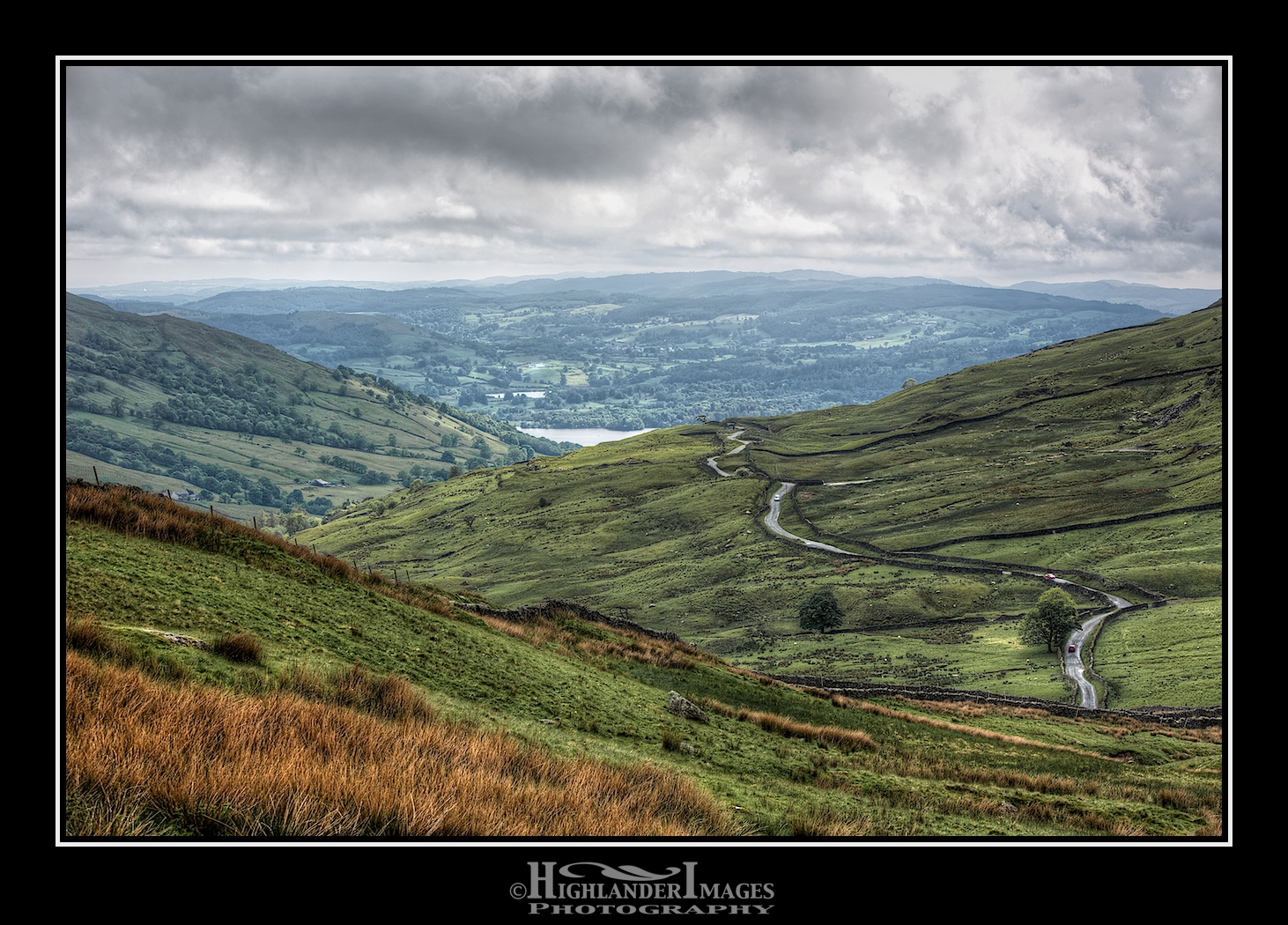
The Long & Winding Road to The Lakes


This is the undulating and winding road from that runs down from the Kirkstone Pass to Ambleside in the Lake District.

The Lake District, or The Lakes, is a mountainous region in Cumbria, North West England and is a popular holiday destination in UK. The majority of the area was designated as the Lake District National Park in 1951. It is the largest of the thirteen National Parks in England and Wales, and the second largest in the UK (after the Cairngorms). It lies entirely within the modern county of Cumbria, shared historically by the counties of Cumberland, Westmorland and Lancashire. All the land in England higher than three thousand feet above sea level lies within the National Park, including Scafell Pike, the highest mountain in England. It also contains the deepest and longest lakes in England, Wastwater and Windermere, respectively.


Thirlmere


Only one of the lakes in the Lake District is called by that name, Bassenthwaite Lake. All the others such as Windermere, Coniston Water, Ullswater and Buttermere are meres, tarns and waters, with mere being the least common and water being the most common. The major lakes and reservoirs in the National Park are given below.
  • Bassenthwaite Lake
  • Brotherswater
  • Buttermere
  • Coniston Water
  • Crummock Water
  • Derwent Water
  • Devoke Water
  • Elter Water
  • Ennerdale Water
  • Esthwaite Water
  • Grasmere
  • Haweswater Reservoir
  • Hayeswater
  • Loweswater
  • Rydal Water
  • Thirlmere
  • Ullswater
  • Wast Water
  • Windermere


Buttermere


Conniston Water


Steamer on Ullswater


Windermere


Thursday, May 17, 2012

Emperor Jade Pagoda, Ho Chi Minh, Vietnam


On the recommendation of Peter Stuckings, fellow photographer based in Ho Chi Minh City, Vietnam, I visited the Emperor Jade Pagoda for a quick photo shoot. The Emperor Jade Pagoda (Chùa Ngọc) is a Taoist Pagoda located at 73 Mai Thi Luu Street, District 3, Ho Chi Minh City, Vietnam. It is also known as the Tortoise Pagoda due no doubt to the large number of tortoises in a pool in front if the temple.


My timing was perfect as on arrival there was a ceremony going on with the head priest leading a procession of followers dressed in black. The chanting, drums and burning incense really added atmosphere to my visit. The highlight was when the overhead sun came out and created these wonderful beams of light through the overhead slatted roof beams cutting through the haze of smoke from the burning incense.

The temple was very authentic and was obviously well used on a daily basis by local worshippers. The ancient old fans hanging from the ceiling made the place look like a set from Indiana Jones and the Temple of Doom.


Sunday, May 06, 2012

Tyler Stableford - Adventure Photographer


Tyler Stableford was in Malaysia today to present a seminar as part of the Canon's EOS Master Craftsmen Southeast Asia Tour 2012. His presentation was very inspiring and showed Tyler's skills in both photography and cinema-photography in a number of adventurous situations. Much of this recent work was shot with the new Canon EOS 1D X and 5D Mk III cameras and used the latest wireless Speedlight 600 EX-RT flash units with the ST-E3-RT transmitter. These situations also displayed the durability and ruggedness of the Canon equipment which was used in some severe weather situations and arduous environments. As well as displaying his work he presented a live shooting demo with one of Malaysia's national cycle team highlighting his approach to making a shoot and using an array of Canon Speedlight 600 EX-RT flash units to enhance the lighting of the shot.


About Tyler Stableford

Aspen photographer and director Tyler Stableford has earned an international clientele for his commercial and editorial work. His clients include Disney, Patagonia, Stetson and The New York Times, among others.


Men's Journal named Tyler one of the seven "World's Greatest Adventure Photographers". He is one of Canon's distinguished Explorers of Light, as well an ambassador for the SanDisk Extreme Team and Adobe's digital imaging software.


Tyler's work has won numerous awards from Communication Arts, Photo District News, American Photography, the International Photography Awards, National Geographic Traveler, and more. His short film "The Fall Line" won the Official Best of Fest competition for "Award-Winning Films To Inspire."

Tyler is a graduate of Dartmouth College. His passion for photography extends beyond commercial work: He volunteers to shoot at least one week per year for nonprofits, and is an active member of the environmental-business organization "1% For The Planet".


You can check out his work at www.tylerstableford.com


Tuesday, May 01, 2012

Abandoned & Decayed - An HDR/URBEX Paradise


Decaying and abandoned old buildings are a treasure trove for the photographer or the urban explorer (URBEX) and these types of environments just shout out for the use of HDR and other post-processing styleization techniques to produce a moody and atmospheric image. The inside of these buildings are normally very dark and where there is bright light spilling in from the outside you can get large changes in dynamic range which can be limiting for most camera sensors. Hence the need for taking multiple bracketed images over a range of exposures to bring out the details in the shadows and properly expose the washed out highlights.

The above image, taken inside an old abandoned colonial house in Georgetown, Penang, Malaysia, was created by tone-mapping 3 bracketed images as shown below.

0 EV
-2 EV
+2 EV
For dynamic ranges like this where there is a large difference between the dark shadows and the bright highlights of the open doors and windows I would normally have taken more brackets; 5 or even 7 to cover the dynamic range of the scene. However in this case I was taking hand held as I was sans tripod so shot off 3 quick brackets to try and miminise any camera movement.

The images were imported into Aperture and then tone mapped using PhotoMatixPro. I subsequently did some additional post-processing in  Viveza 2 from Nik Software to enhance the colour and texture of some areas such as the wall on the left hand side and the wonderful eroded ceiling beams.

Looking at the final image compared with the "normal" 0 EV photo it really highlights the benefits of HDR techniques to bring out the full dynamic range of the scene.


Sunday, April 01, 2012

Bukit Nanas Heritage Buildings


Right in the heart of Kuala Lumpur and under the shadow of the KL Tower at Bukit Nanas are a variety of wonderful old heritage buildings which have been left to decay and rot in the hot tropical heat and humidity. On the main Jalan Raja Chulan road is a row of houses which in their day probably represented the very best and elite accommodation in the city. These 8 houses in a row have an elaborate crest on the wall with the letters OES and the date of 1931 but there is little else I can find out about them.

Amazingly there are some people still living in one or more of the houses but no doubt these wonderful heritage buildings will eventually disappear and this prime land be re-developed.


Walking behind this row of houses I came across another magnificent old house right below the KL Tower. This house was habited by an Indian family who were more than welcome to me taking photographs of their house and even their dog posed for the photo! This location is rather unique being on the Bukit Nanas hill surrounded by jungle trees and foliage but yet it is right in the middle of the city.


There were also a number of other rundown and decaying buildings I discovered close by which similarly in their time must have been prime real estate.


Monday, March 12, 2012

Tango


Tango, a distinctive dance and the corresponding musical style of tango music, began in the working-class port neighborhoods of Buenos Aires (Argentina); and years later in Montevideo, Uruguay; the area of the Rio de la Plata.
There are a number of theories about the origin of the word "tango". One of the more popular in recent years has been that it came from the Niger–Congo languages of Africa. Another theory is that the word "tango", already in common use in Andalusia to describe a style of music, lent its name to a completely different style of music in Argentina and Uruguay.

The dance form derives from the Cuban habanera, the Argentine milonga and candombe, and is said to contain elements from the African community in Buenos Aires, influenced both by ancient African rhythms and the music from Europe.
Even though the present forms developed in Argentina from the mid 19th century, there are earlier written records of Tango dances in Cuba and Spain, while there is a flamenco Tangos dance that may share a common ancestor in a minuet-style European dance. All sources stress the influence of the African communities and their rhythms, while the instruments and techniques brought in by European immigrants played a major role in its final definition, relating it to the Salon music styles to which Tango would contribute back at a later stage, when it became fashionable in early 20th century Paris.


In Argentina, the word Tango seems to have first been used in the 1890s. In 1902 the Teatro Opera started to include tango in their balls. Initially tango was just one of the many available local dances, but it soon became popular throughout society, as theatres and street barrel organs spread it from the suburbs to the working-class slums, which were packed with hundreds of thousands of European immigrants. The development of the Tango had influences from the cultures of several peoples that came together in these melting pots of ethnicities. For this reason Tango is often referred to as the music of the immigrants to Argentina.


During the period 1903–1910 over a third of the 1,000 gramophone records released were of tango music, and tango sheet music sold in large quantities. In 1910 the bandoneon was introduced to Buenos Aires from Germany and it became linked inextricably with tango music from then on. In 1912, Juan "Pacho" Maglio was very popular with his recorded tangos featuring the bandoneon accompanied by flute, violin and guitar. Between 1910 and 1920, tango featured on 2,500 of the 5,500 records released.
As the dance form became wildly popular with upper and middle classes around the world, Argentine high society adopted the previously low-class dance form as their own. In 1913, tango began to move from the dark side of town to elegant dance palaces. In 1916, Roberto Firpo, an extremely successful bandleader of the period, cemented the arrangements for standard tango sextet: two bandoneons, two violins, piano and double bass. Firpo heard a march by Uruguayan Gerardo Matos Rodríguez and adapted it for tango, creating the popular and iconic La Cumparsita.


By 1912, dancers and musicians from Buenos Aires travelled to Europe and the first European tango craze took place in Paris, soon followed by London, Berlin, and other capitals. Towards the end of 1913 it hit New York in the USA, and Finland. These exported versions of Tango were modified to have less body contact ("Ballroom Tango"); however, the dance was still thought shocking by many, as had earlier been the case with dances such as the Waltz. In 1922 guidelines were first set for the "English" (international) style of ballroom tango, but it lost popularity in Europe to new dances including the Foxtrot and Samba, and as dancing as a whole declined due to the growth of cinema.


In 1917, folk singer Carlos Gardel recorded his first tango song Mi Noche Triste, forever associating tango with the feeling of tragic love as revealed in the lyric.
Classically-trained musicians weren't associated with tango music until Julio De Caro, violinist, formed an orchestra in 1920 and made the tango more elegant, complex and refined, as well as slowing the tempo somewhat. With Pedro Laurenz on bandoneon, De Caro's orchestra was famous for over a decade.


In Argentina, the onset in 1929 of the Great Depression, and restrictions introduced after the overthrow of the Hipólito Yrigoyen government in 1930 caused Tango to decline. Its fortunes were reversed as tango again became widely fashionable and a matter of national pride under the government of Juan Perón. Tango declined again in the 1950s with economic recession and as the military dictatorships banned public gatherings, followed by the popularity of rock and roll. The dance lived on in smaller venues until its revival in the 1980s following the opening in Paris of the show Tango Argentino The Broadway musical Forever Tango and in Europe Tango Pasión followed.


All photographs and video posted here were shot at the Gala Dinner at the Raintree Club, Kuala Lumpur during the 5th Kuala Lumpur Tango Festival which took place from 8th to 11th March 2012, organized by Marguerite Brodie and Andreas Lehrke. Marguerite and Andreas started Tango Malaysia which run tango classes and workshops at various locations in KL.