You can check out his work at www.tylerstableford.com
Showing posts with label Canon. Show all posts
Sunday, May 06, 2012
Tyler Stableford - Adventure Photographer
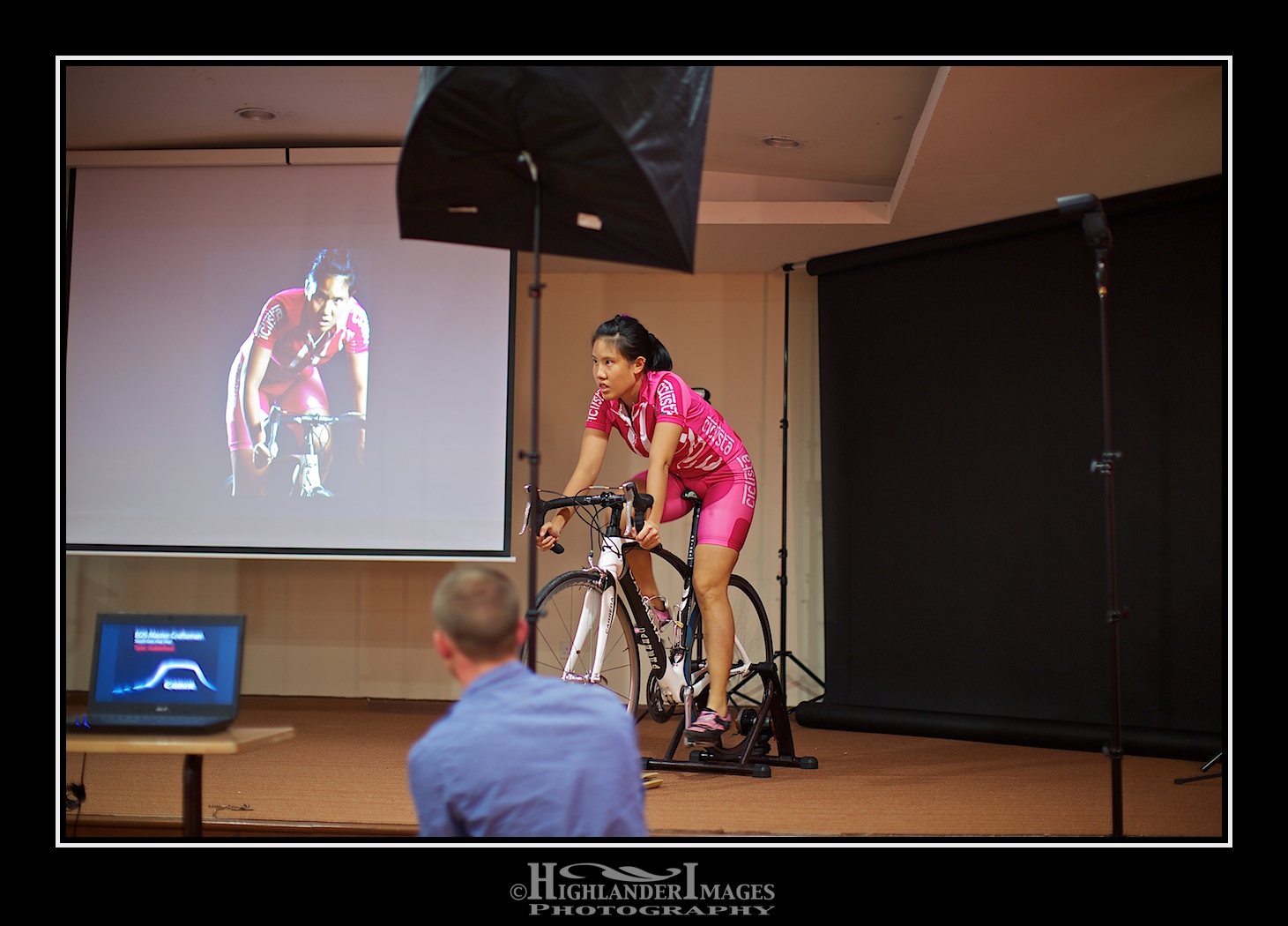
Tyler Stableford was in Malaysia today to present a seminar as part of the Canon's EOS Master Craftsmen Southeast Asia Tour 2012. His presentation was very inspiring and showed Tyler's skills in both photography and cinema-photography in a number of adventurous situations. Much of this recent work was shot with the new Canon EOS 1D X and 5D Mk III cameras and used the latest wireless Speedlight 600 EX-RT flash units with the ST-E3-RT transmitter. These situations also displayed the durability and ruggedness of the Canon equipment which was used in some severe weather situations and arduous environments. As well as displaying his work he presented a live shooting demo with one of Malaysia's national cycle team highlighting his approach to making a shoot and using an array of Canon Speedlight 600 EX-RT flash units to enhance the lighting of the shot.
Aspen photographer and director Tyler Stableford has earned an international clientele for his commercial and editorial work. His clients include Disney, Patagonia, Stetson and The New York Times, among others.
Tyler's work has won numerous awards from Communication Arts, Photo District News, American Photography, the International Photography Awards, National Geographic Traveler, and more. His short film "The Fall Line" won the Official Best of Fest competition for "Award-Winning Films To Inspire."
Tyler is a graduate of Dartmouth College. His passion for photography extends beyond commercial work: He volunteers to shoot at least one week per year for nonprofits, and is an active member of the environmental-business organization "1% For The Planet".
You can check out his work at www.tylerstableford.com
Labels:
1D X,
5D Mk III,
adventure,
Canon,
EOS,
Master Craftsman,
photography,
seminar,
Southeast Asia,
tour,
Tyler Stableford
Friday, January 06, 2012
A Perspective of Shih Chung School, Penang
This imposing old tumbledown, heritage building in Georgetown, Penang used to be the Shih Chung School but actually has a much longer and interesting history.
The once glorious mansion was called Goh Chan Lau (literally meant five-storey bungalow) by the local Chinese and was built by millionaire Cheah Tek Soon, founder and partner of Penang Khean Guan Insurance Company (the first Chinese insurance company in the Straits Settlement in year 1885). The Cheahs are one of the big five Hokkien families in the state.
In 1908, the building was sold off to Tye Kee Yoon, another eminent personality at that period. and the mansion then housed the Chinese Residency for a point of time before it became a hotel, the Raffles-by-the-Sea. The hotel was a failure and had to be shut down.
Later on, Kee Yoon, who was a Hakka, collaborated with another millionaire Leong Fee to set up the Shih Chung School within Goh Chan Lau in the same year. Leong Fee, whose full name is Liang P'i Joo, also set up a girl's school called P'i Joo Girls' School which occupied the upper floor of Goh Chan Lau. In 1929 Shih Chung School was moved to Love Lane. By 1938, the school became so overcrowded that a branch had to be established and Goh Chan Lau became the choice destination again. From then on, Shih Chung existed as a main school and a branch school. The periods in between had the mansion leased to the Government Branch School.
During the Second World War,Goh Chan Lau was used as an administrative headquarters for the Japanese Military and therefore the branch school had to relocate to its main body. There the combined school co-existed until 1949, when the Shih Chung Branch School returned to occupy Goh Chan Lau. In 1961, the launch of the Uniform Salary Scale for Teachers saw the full severance of Shih Chung Main School from Shih Chung Branch School. The branch school again relocated, this time to its current premises at Sungai Nibong in year 2000, when the urbanisation of Penang Island brought forth a collapse in the population of the Inner City, hence a precipitous drop in student attendance. Goh Chan Lau was later sold by the Tye family trustee, when the restriction period in the will expired (after three generations). The building had been purchased by a new owner, Malaysia Vegetable Oil Refinery Sdn Bhd in 1993. Now an abandoned building, the new owner had initially planned to turn it into a columbarium (a place for the respectful and usually public storage of cinerary urns - i.e. urns holding a deceased’s cremated remains) but was met with harsh protest by the people of Penang. The site is apparently now set for demolition and a condominium built on the site.
An interesting point to note is that the Tye family trust was an early example of a Hakka family that left a will for the descendants, which provided that the family estate including the Goh Chan Laucannot be sold for at least three generations, and 10 per cent of estate revenue is to be donated for education purpose. It is Chinese belief that the estate of a family cannot be passed more than three generations or will be finished by the third generation. The will of the Tye family provides clauses to mitigate the risk on that belief and provided clauses in the will, that the family estate cannot be sold prior to three generations. It also provided for a clause that 10 per cent of estate revenue to be used for education purpose. This reflected the wisdom of the Tye family, and their trust was able to support the Chinese education in Penang for long time.
Tilt-Shift Lens Comparison
The main image above was shot using a Canon TS-E 17mm L lens and is an HDR processed image from 7 bracketed shots. Just to show the comparison between a shifted image and a normal one, the two photos below illustrate the shot:
1) using the TS-E 17mm L lens without shift and the camera body then tilted up to capture the entire building
2) using the shift function of the lens to properly align the vertical perspective of the architecture.
The un-shifted photo shows the typical leaning verticals giving the viewer an impression that the building is falling backwards. This is caused by the wide angle lens and the tilt of the camera body which is needed to capture the whole building.
The shifted photo gives better perspective control of the verticals. This tilt-shift lens is therefore very useful for properly capturing photographs of architecture where perspective control is important.
1) Canon TS-E 17mm L - no shift
2) Canon TS-E 17mm L with vertical shift to align perspective
Labels:
architecture,
Canon,
Cheah Tek Soon,
Georgetown,
Goh Chan Lau,
HDR,
heritage,
historical,
Penang,
perspective,
school,
Shih Chung,
teach,
tilt shift,
TS-E 17mm,
Tye Kee Yoon,
urbex,
wide angle
Thursday, January 05, 2012
The Blue Mansion
Having had a few days break from the blog over Xmas and New Year it's time to start the occasional post again as we make our way into 2012. I visited Penang over the festive period and had the opportunity to stay at the wonderfully historic Blue Mansion .... or Cheong Fatt Tze Mansion which has been beautifully and meticulously restored to its former glory. This venue provided some great photo opportunities and the above shot exemplifies that with the deep indigo blue colored walls, the rustic floor tiles and the stunningly detailed and colored spiral staircase.
I also had the opportunity during this trip to test out a new lens which I have added to my arsenal of Canon L lenses. I have often wondered about the benefits of a tilt-shift lens and given the high cost of these particular lenses plus the fact that I may not use it enough to justify the cost I have put off this purchase. However I eventually relented (as I often do with camera equipment) and picked up the shiny new Canon TS-E 17mm f/4.0L just prior to the Xmas break.
I love my existing wide angle 16-35mm f/2.8 L lens but one small aggravating feature it has, particularly when taking architecture, are the sloping perspectives which give the impression of the tall buildings falling backwards. At times this can be used to good advantage but in many circumstances it's good to be able to keep everything orthogonal.
I will share some comparison shots of this new tilt-shift lens in a later post but this shot here shows the power of such a lens. Placing the camera body on a tripod and leveling this it's a simple job then to shift the lens up or down to frame the shot and retain perfect verticals. The other great advantage here is the ability to take three shots, one with no lens shift, the other two shots with positive and negative lens shift to capture the scene upwards and downwards. Then it's a very simple task to stitch the three frames into a portrait panorama and as there is no lens distortion makes the stitching process simple and flawless compared to when I have previously done this with a standard wide angle lens. In a similar fashion with the tilt-shift lens adjusted by 90 degrees you can easily capture a landscape panorama with three shots.
I think the shot shown here convinces me of the great benefits of a tilt-shift lens and I am sure that this will probably become one of my favorite lenses to use especially for architectural shots or panoramas.
Labels:
Blue Mansion,
Canon,
Cheong Fatt Tze,
Georgetown,
heritage,
historical,
Malaysia,
panorama,
Penang,
perspective,
tilt shift,
TS-E 17mm,
wide angle
Subscribe to:
Posts (Atom)


.jpg)