Here is the complete collection of all my Nepal blog postings for easy reference including an annotated picture of the Himalayan peaks as viewed from Tengboche Monastery, Tengboche, Nepal.
It was freezing cold when we arose for the last day's trek from Phakding to Lukla and we all huddled around the log fire with our hot tea to get some warmth in us before heading out after breakfast. As we headed off down the trail out of Phakding we passed once again through the agriculturally rich area beside the Dudh Kosi River and the many small villages along the way.
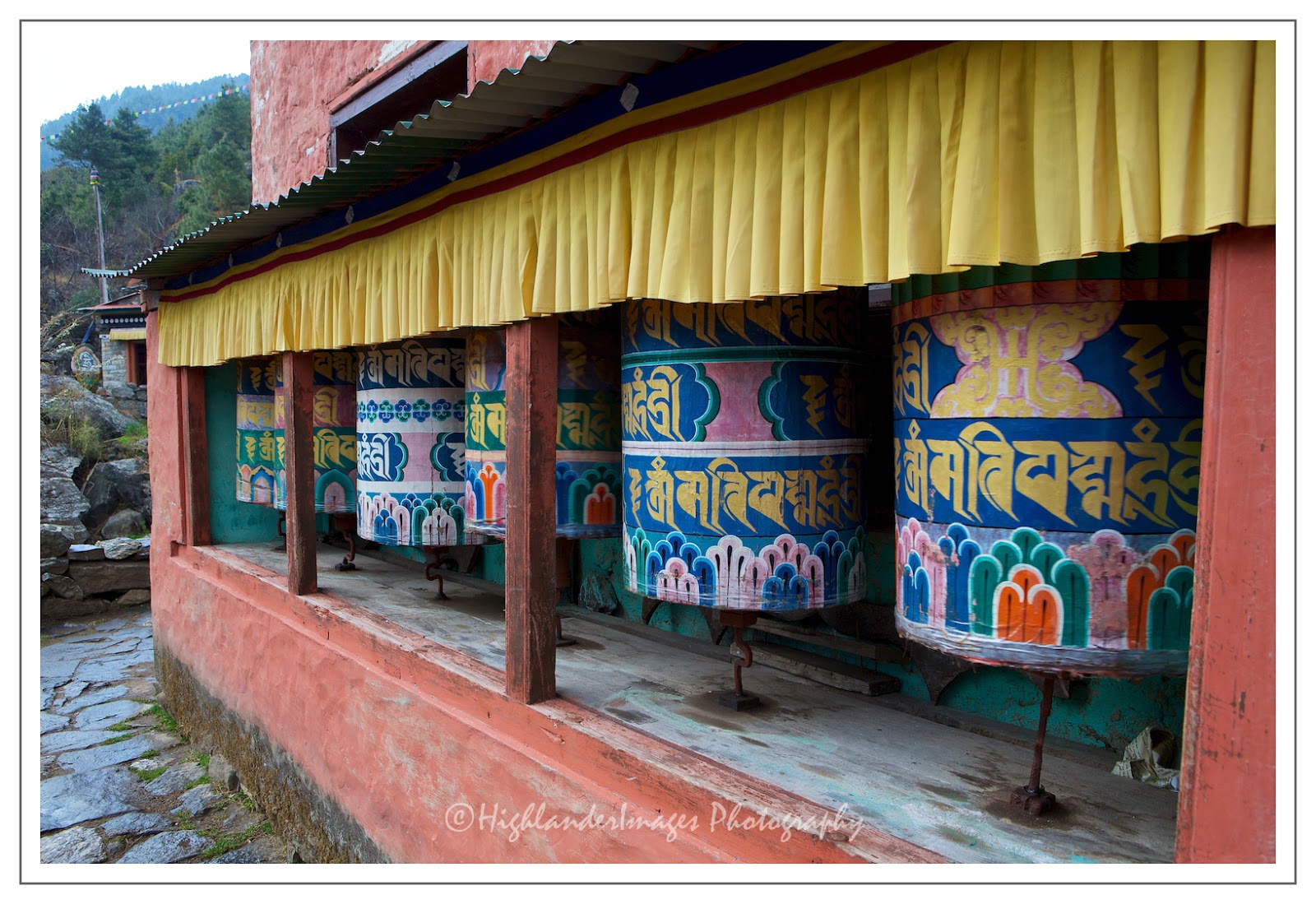
We passed the many Mani stones, Buddhist stupas, small monasteries and brightly painted prayer wheels beside the trail, these colourful items providing some good photo opportunities.
The small villages and surrounding field were all neatly tended with vegetables and rice being grown. We stopped at a small shop to buy some water and the lady owner insisted on me photographing her and her baby which of course I duly complied with. Next to the shop a lady was busy laying out some chilli seeds to dry in the sun. There were again many large trains of donkeys heading down the trail this morning obviously to load back up with goods from Lukla.
After a dull start to the morning it became a pleasant day for the walk back down the valley. Beautiful white tree blossom and blue, alpine style flowers could be seen in the fields beside the trail and as we made our way through the small villages it was interesting to watch some of the locals working and the children playing. Everything is done by hand here and a group of men were busy mending a bridge supporting wall, chisseling large rocks by hand.
Soon we were getting close to Lukla and the end of our long trek and once again the trail started to ascend from the valley floor up towards Lukla. I was interested to watch a couple of local boys play table tennis outside their house. A small group of Nepalese policemen marched down the trail past me all dressed up in their smart uniforms - obviously rushing off to an incident of major Himalayan importance. The last section was steep but as we were in sight of the finish line we made Lukla in good time. It was a great feeling to cross under the arch at the edge of Lukla after 7 days of constant trekking over rough, steep trails. We reached our lodge and sat down for a late lunch and celebratory Everest beer and Everest burger. Our trusty porter, Gunga Rai, had been invaluable in carrying our gear in the rucksack and also he stuck very close to Suit Yoo the whole route assisting her over some difficult sections.
It was a great feeling to cross under the arch at the edge of Lukla marking the start/end of the trail after 7 days of constant trekking over rough, steep trails. We reached our lodge and sat down for a late lunch and celebratory Everest beer and Everest burger. Our trusty sherpa porter, Gunga Rai, had been invaluable in carrying all our gear in the rucksack and also sticking close to Suit Yoo like a shadow the whole route assisting her over some difficult sections. Suit Yoo had become quite attached to him and I was afraid I may have to buy him a ticket to Malaysia to continue to follow my wife everywhere!
Having reached Lukla, and survived the most dangerous airport in the world, we were now ready to start our 4 day trek up to Tengboche at 3,900m and then 3 day trek back. Tengboche was half way up the Everest Base Camp Trail, the base camp being at 5,500m and another 3 days trek past Tengboche. After some local lunch we arranged the sherpa porters and with our trekking guide Bir Bador we headed out through the town and onto the gentle first half day trek to Phakding. At the end of the town there is an arch marking the start of the Everest Base Camp Trail and the stone trail initially descends steeply making it an easy start to the trek. From Lukla to Phakding there is a drop in elevation of around 200m. It was mentally noted however that this easy first section would soon to become the difficult final section on our return to Lukla!
This trail ran through numerous small rural villages surrounded by stepped, cultivated fields growing rice and vegetables such as cabbage, lettuce, and potatoes. There were also a number of tea houses and small shops to stop at for refreshments and snacks.
Dzo, a hybrid between yak and domestic cattle, were commonly seen on the trail carrying goods up towards Phakding and beyond. Donkeys were also commonly used and we came across large "donkey trains" heading up or down the trail, usually fully laden on the route up with large bags of goods, gas bottles, etc and coming back down the trail empty ready for the next load. Also, a common sight on the trek were numerous porters, both male and female, young and old, carrying large loads of goods up the trail. We soon got used to listening for the bells of the dzo or donkey trains and moved to one side of the trail to allow them to pass. Occasionally we would see small horses on the trail usually being used to transport people rather than goods.
Prayer wheels were a very common sight on the Everest Base Camp Trail These were brightly painted and inscribed and came in all sizes, some having their own building to house them. A prayer wheel is a cylindrical "wheel" on a spindle made from metal, wood, stone, leather or coarse cotton. Traditionally, the mantra Om Mani Padme Hum is written in Newari language (Ranjana script) on the outside of the wheel. Also sometimes depicted are Dakinis, Protectors and very often the 8 auspicious symbols Ashtamangala. According to the Tibetan Buddhist tradition based on the lineage texts regarding prayer wheels, spinning such a wheel will have much the same meritorious effect as orally reciting the prayers. There were also occasional small monasteries and Buddhist stupas along the trail.
Along the paths of regions under the influence of Tibetan or Nepalese Buddhism the traveller is often confronted with Mani walls and these were commonly seen all along the Everest Base Camp Trail. These stone structures comprise intricately carved stone tablets, most with the inscription "Om Mani Padme Hum" which loosely translates to "Hail to the jewel in the lotus". These walls should be passed or circumvented from the left side, the clockwise direction in which the earth and the universe revolve, according to Buddhist doctrine. They are sometimes close to a temple or chorten, sometimes completely isolated and range from a few metres to a kilometre long and one to two metres high. They are built of rubble and sand and faced with mani stones engraved in the elegant Nepalese/Tibetan script.
The trail eventually came down close to the Dudh Kosi River and followed this to Phakding where we would spend the first night. The scenery of river, valley and rugged mountains was beautiful and many of the trees in the fields were in blossom adding to this beauty. It reminded me somewhat of Scotland (without the good whisky I may add!) although on a much larger scale. The mountains were no doubt higher … the highest mountain in Scotland being Ben Nevis at 1,344m and of course Mount Everest here (but yet to see) at 8,848m - some six and a half times the size!!
.... you will find periodic photograph postings plus my rambling thoughts on photography, image processing, tips & techniques, camera equipment, software, HDR, urbex, panoramas, slideshows, photo events, travel destinations, documentaries, photojournalism, humour, nostalgia ... and sometimes perhaps a few surprises!
HighlanderImages Photography offers a diverse range of images focused primarily on Asia with a photojournalistic/documentary style and a Scottish twist!
Profitable Photography
How to easily start up your own profitable photography business from home, just like I did - and make $720 in just 3 hours per week part time! Digital Photography Business
"Documentary photography and photojournalism are based on perception, not on technology. Photographs are a product of heart and mind and the ability to connect."
James Nachtwey
"Watch and wait on life. If you wait people will forget your camera and the soul will drift up into view"
Steve McCurry
"There are no rules for good photographs, there are only good photographs."
Ansel Adams "If your pictures aren't good enough, you're not close enough."
Robert Capa
"f8 and be there"
Weegee (Arthur Fellig)
"Get your camera in a different place"
Joe McNally
"There is no such thing as a perfect image ... only a perfect moment."
Joe Buissink
"Available light is any damn light that is available"
W. Eugene Smith
"Having a camera makes you no more a photographer than having a hammer and some nails makes you a carpenter."







 Posts
Posts


