Wednesday, February 29, 2012

The Lost World of Kinabalu


A tropical, jungle-clad, cloud enveloped and rugged mountain terrain with multiple micro climates hosting mesozoic mosses, prehistoric fungi, Jurassic tree ferns, dwarf shrubs, colourful orchids, carnivorous primeval pitcher plants, gigantic parasitic flowers which stink of rotting flesh, a multitude of unique and uncategorized flora and fauna with mysterious rugged trails leading through dense and unexplored forests up to the towering heights of the massive mountain peaks and ridges. 

This could be the screenplay setting of a movie such as The Lost World or even Jurassic Park but in fact is a description of Mount Kinabalu National Park in Borneo. This UNESCO world heritage site remains once of the least explored parts of the world and is home to one of the richest and most bizarre diversity of animal and plant life you will find on this planet. It is indeed like entering a time warp which takes you back to the prehistoric days of dinosaurs or walking into the film set of Steven Spielberg's Jurassic Park. As you walk on the many trails through this mystical environment you would not at all be surprised to stumble upon a Velociraptor or Stegosaurus popping out from behind the trees and bushes.


Dominating this whole area are the massive slabs of granite rock which soar over 4km into the clouds. The ragged skyline ridges of the mountain in many ways resemble the back of a Stegosaurus further exemplifying the Lost World analogy. Mount Kinabalu is the highest mountain in Malaysia and Borneo and is also one of the youngest mountains, still growing at some 0.5cm per year. 


This is certainly one of the most formidable and commanding mountains you will see but for all of this, is easily accessible and can be climbed, or rather walked, with relative ease. I use the term "relative ease" lightly, as having walked the first 2km up the Summit Trail from the Mesilau Gate park entrance on the east side of Mount Kinabalu, it is no walk in the park! It is however one of the best trail walks I have done and one day I plan to explore more of this trail and perhaps even conquer the mountain itself. 


Also of interest at the Mesilau Gate entrance there is a short private trail walk you can take, known as the Nepenthes rajah Trail or Nepenthes Garden, named because of the proliference of these incredible pitcher plants. These carniverous plants range from tiny specimens no larger than your finger nail up to the large Nepenthes rajah species which can hold up to 3.5 litres of water and 2.5 litres of acidic digestive juices. These incredible plants have an ingenious hinge mechanism allowing them to close off when it is is raining to prevent the acidic brew inside the plant from diluting or opening up to allow unwary insects, frogs, lizards and even birds to fall into the attractive nectar scented trap. A unique serrated ridge on the underside of the pitcher plant urn prevents the trapped insects from escaping.


Close to the Mount Kinabalu Park is the small town of Poring where you can visit the famous Poring hot springs or walk on the elevated canopy walk high in the trees. Around this area it is also possible to see the largest flower in the world, the Rafflesia, named after Sir Thomas Stamford Raffles. You will see signs on the roadside advertising flowering Rafflesia plants and for a small fee a guide will take you through the jungle to the place where the flower is blooming. Rafflesia arnoldii has the largest single flower of any flowering plant and is sometimes known as the corpse flower because of the rotting flesh smell exuded by the plant. The plant has no stem, leaves or true roots and is an endoparasite of the vines of genus Tetrastigma spreading its absorptive organ, the haustorium, inside the tissue of the vine. The only part of the plant that can be seen outside of the host vine is the five petaled flower. These plants flower over a period of only a few days and then decompose into a black mulch.


So whether you come to climb Mount Kinabalu, play golf on the highest golf course in South East Asia at Mount Kinabalu Golf Course or explore the trails at the lower levels of the mountain this park offers so much from the stark, rugged scenery of the mountain peaks, the incredible variety of flora and fauna and the fact that you are in a relatively unexplored part of the world. Who knows what you may find.


Tuesday, February 07, 2012

Life In A Bubble


The London Eye is a popular tourist visit and provides some stunning views over central London. This image I took was processed to a black and white image and then the colour brought back into the passenger bubble for effect.

Monday, February 06, 2012

Saigon Street Scenes


Saigon, or rather Ho Chi Minh City as it is called now, is a wonderful place for observing street life. It is a vibrant Asia city where many activities occur on the street from peddling goods to preparation and eating of a multitude of foods. Many years ago the bicycle was the king here but this has now been replaced by the motorcycle which predominates the traffic in the city. On Sundays people simply cruise the streets on the motorbikes and it is a real challenge to actually cross the road given the density of the bike traffic. The trick is to slowly, but positively, walk out into the street and the bikes will part and move around you ..... that theory has held up for me so far!!


Friday, January 27, 2012

Leopard - Panthera pardus


The leopard, Panthera pardus, is a member of the Felidae family and the smallest of the four "big cats" in the genus Panthera, the other three being the tiger, lion, and jaguar. The leopard was once distributed across eastern and southern Asia and Africa, from Siberia to South Africa, but its range of distribution has decreased radically because of hunting and loss of habitat. It is now chiefly found in sub-Saharan Africa; there are also fragmented populations in the Indian subcontinent, Sri Lanka, Indochina, Malaysia, Indonesia, and China. Because of its declining range and population, it is listed as a "Near Threatened" species on the IUCN Red List.
Compared to other members of the Felidae family, the leopard has relatively short legs and a long body with a large skull. It is similar in appearance to the jaguar, but is smaller and more slightly built. Its fur is marked with rosettes similar to those of the jaguar, but the leopard's rosettes are smaller and more densely packed, and do not usually have central spots as the jaguars do. Both leopards and jaguars that are melanistic (completely black or very dark) are known as black panthers.
The species' success in the wild is in part due to its opportunistic hunting behavior, its adaptability to habitats, its ability to run at speeds approaching 58 kilometres per hour (36 mph), its unequaled ability to climb trees even when carrying a heavy carcass, and its notorious ability for stealth. The leopard consumes virtually any animal that it can hunt down and catch. Its habitat ranges from rainforest to desert terrains.


These photos were taken in 2002 at the Ngala Private Game Reserve which is adjacent to the famous Kruger National Park in South Africa. Having arrived at the reserve only a couple of hours before we immediately left on the early evening safari in an open land rover and this one one of the first sights we saw - this magnificent leopard in a tree with a kill of a young impala (African antelope) in the next tree. As we sat directly below the tree it allowed me a wonderful opportunity to capture multiple images of this beautiful cat as she lounged, yawned and then casually leapt to the other tree to gnaw away at the impala.

Monday, January 23, 2012

The Year of the Water Dragon


Gong Xi Fa Cai! .... or Happy Chinese New Year ..... the Year of the Water Dragon is upon us. 
Chinese New Year is the most important of the traditional Chinese holidays. In China, it is known as "Spring Festival," the literal translation of the Chinese name 春節, since the spring season in Chinese calendar starts with lichun, the first solar term in a Chinese calendar year. It marks the end of the winter season, analogous to the Western carnival. The festival begins on the first day of the first month in the traditional Chinese calendar and ends with Lantern Festival which is on the 15th day. Chinese New Year's Eve, a day where Chinese families gather for their annual reunion dinner, is known as ChúxÄ« (除夕) or "Eve of the Passing Year." Because the Chinese calendar is lunisolar, the Chinese New Year is often referred to as the "Lunar New Year".
Chinese New Year is the longest and most important festivity in the Chinese calendar. The origin of Chinese New Year is itself centuries old and gains significance because of several myths and traditions. Chinese New Year is celebrated in countries and territories with significant Chinese populations, such as Mainland China, Hong Kong, Indonesia, Macau, Malaysia, Philippines, Singapore, Taiwan, Thailand, and also in Chinatowns elsewhere. Chinese New Year is considered a major holiday for the Chinese and has had influence on the lunar new year celebrations of its geographic neighbors. These include Korean (Seollal), Bhutanese (Losar), and Vietnamese cultures.
Within China, regional customs and traditions concerning the celebration of the Chinese new year vary widely. People will pour out their money to buy presents, decoration, material, food, and clothing. It is also the tradition that every family thoroughly cleans the house to sweep away any ill-fortune in hopes to make way for good incoming luck. Windows and doors will be decorated with red colour paper-cuts and couplets with popular themes of "good fortune" or "happiness", "wealth", and "longevity". On the Eve of Chinese New Year, supper is a feast with families. Food will include such items as pigs, ducks, chicken and sweet delicacies. The family will end the night with firecrackers. Early the next morning, children will greet their parents by wishing them a healthy and happy new year, and receive money in red paper envelopes. The Chinese New Year tradition is to reconcile, forget all grudges and sincerely wish peace and happiness for everyone.
Although the Chinese calendar traditionally does not use continuously numbered years, outside China its years are often numbered from the reign of the Yellow Emperor. But at least three different years numbered 1 are now used by various scholars, making the year beginning in AD 2012 the "Chinese Year" 4710, 4709, or 4649.

Sunday, January 15, 2012

Please Mr. Postman


Wherever I travel I try to capture images of post boxes and letter boxes. These brightly colored boxes can be quite different in many different parts of the world and it has been a sort of unwritten, background activity of mine whenever I'm traveling. So when I spot a post box I grab an image for what purpose I just don't know .... call it a letter box fetish! So here I have decided to collate all my most beautiful post box images and post them (pun intended) here on my blog.


Wednesday, January 11, 2012

Sleep


All over Asia I have witnessed an incredible ability of people to sleep almost anywhere. No matter what cramped situation, noisy location or downright dirty environment people have no problems in making themselves comfortable and getting some shut eye. Oh how I wish I could learn that ability.  Even on long haul flights of 12 hours I am the guy who is sitting straight up with eyes wide open while everyone around me is making the most of it.

The meat market above in Siem Reap was a great example where this lady simply slung up her hammock over the stall and got busy with the Zzzz's.


So whether it's a hammock a floor mat or a chair Asians are well experienced of getting horizontal if only for a short while. This lady above has neatly propped her legs up the wall and placed a straw fan over her eyes as shades.


And ... it doesn't really matter what you look like. Again the Asians have apparently no shame or worry about appearances ..... this old guy in Urumqi in West China has laid himself out in the middle of the town square and taken off his shoes to get comfy. Holy socks ...... not a problem. They call it ventilation!


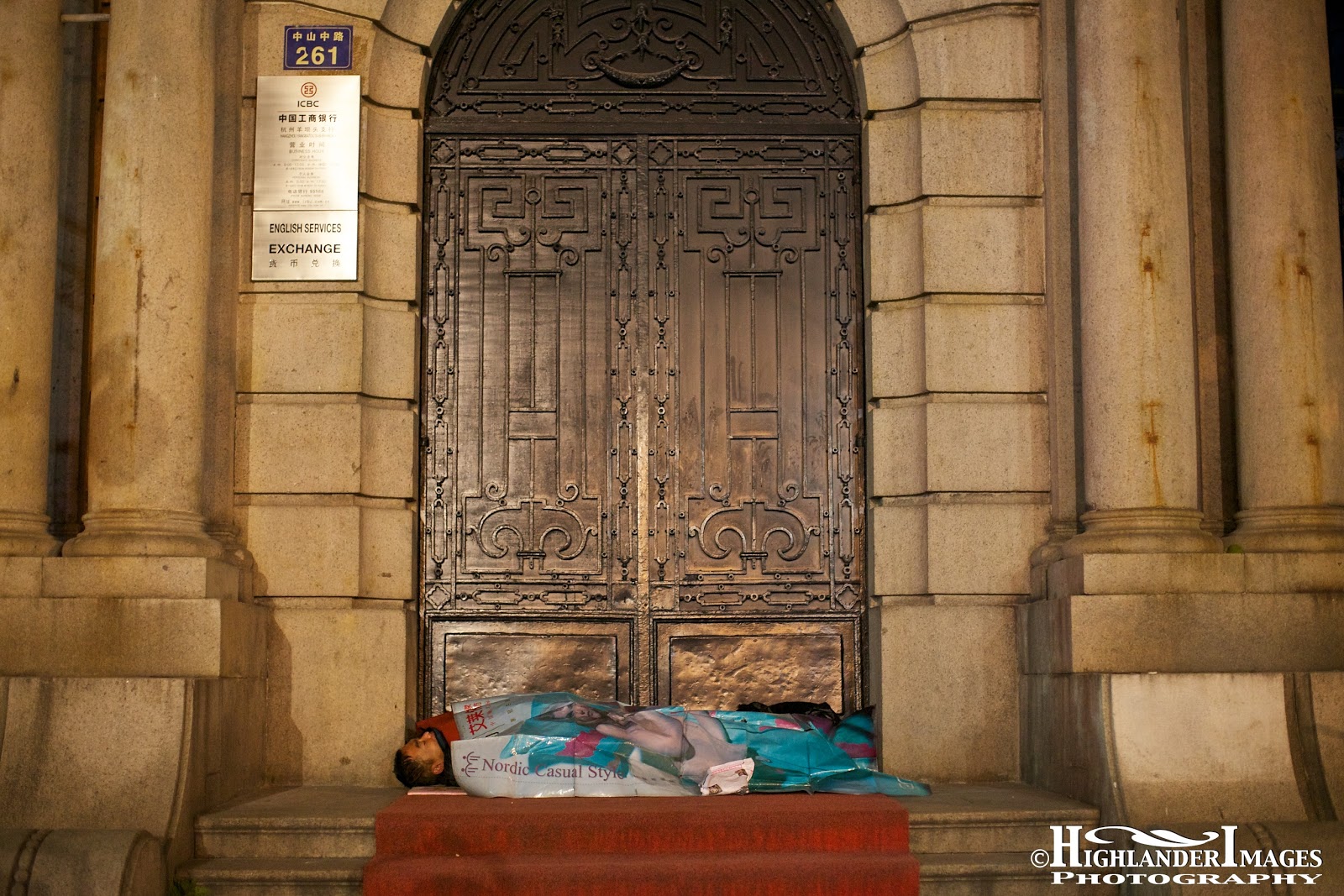
This guy in Hangzhou, China has chosen a perfect spot in front of some grand old doors and complete with his "Nordic Casual Style" sleeping bag he can sleep throughout the cold winter night.


Or if you're a taxi driver, lorry driver or trishaw rider you have already the perfect place to stretch out and snooze as seen here with this trishaw rider in Yogyakarta, Indonesia.


Friday, January 06, 2012

A Perspective of Shih Chung School, Penang


This imposing old tumbledown, heritage building in Georgetown, Penang used to be the Shih Chung School but actually has a much longer and interesting history.  The once glorious mansion was called Goh Chan Lau (literally meant five-storey bungalow) by the local Chinese and was built by millionaire Cheah Tek Soon, founder and partner of Penang Khean Guan Insurance Company (the first Chinese insurance company in the Straits Settlement in year 1885). The Cheahs are one of the big five Hokkien families in the state. In 1908, the building was sold off to Tye Kee Yoon, another eminent personality at that period. and the mansion then housed the Chinese Residency for a point of time before it became a hotel, the Raffles-by-the-Sea. The hotel was a failure and had to be shut down. 

Later on, Kee Yoon, who was a Hakka, collaborated with another millionaire Leong Fee to set up the Shih Chung School within Goh Chan Lau in the same year. Leong Fee, whose full name is Liang P'i Joo, also set up a girl's school called P'i Joo Girls' School which occupied the upper floor of Goh Chan Lau. In 1929 Shih Chung School was moved to Love Lane. By 1938, the school became so overcrowded that a branch had to be established and Goh Chan Lau became the choice destination again. From then on, Shih Chung existed as a main school and a branch school. The periods in between had the mansion leased to the Government Branch School.  

During the Second World War,Goh Chan Lau was used as an administrative headquarters for the Japanese Military and therefore the branch school had to relocate to its main body. There the combined school co-existed until 1949, when the Shih Chung Branch School returned to occupy Goh Chan Lau. In 1961, the launch of the Uniform Salary Scale for Teachers saw the full severance of Shih Chung Main School from Shih Chung Branch School. The branch school again relocated, this time to its current premises at Sungai Nibong in year 2000, when the urbanisation of Penang Island brought forth a collapse in the population of the Inner City, hence a precipitous drop in student attendance. Goh Chan Lau was later sold by the Tye family trustee, when the restriction period in the will expired (after three generations). The building had been purchased by a new owner, Malaysia Vegetable Oil Refinery Sdn Bhd in 1993. Now an abandoned building, the new owner had initially planned to turn it into a columbarium (a place for the respectful and usually public storage of cinerary urns -  i.e. urns holding a deceased’s cremated remains) but was met with harsh protest by the people of Penang. The site is apparently now set for demolition and a condominium built on the site. 

An interesting point to note is that the Tye family trust was an early example of a Hakka family that left a will for the descendants, which provided that the family estate including the Goh Chan Laucannot be sold for at least three generations, and 10 per cent of estate revenue is to be donated for education purpose. It is Chinese belief that the estate of a family cannot be passed more than three generations or will be finished by the third generation. The will of the Tye family provides clauses to mitigate the risk on that belief and provided clauses in the will, that the family estate cannot be sold prior to three generations. It also provided for a clause that 10 per cent of estate revenue to be used for education purpose. This reflected the wisdom of the Tye family, and their trust was able to support the Chinese education in Penang for long time. 

Tilt-Shift Lens Comparison

The main image above was shot using a Canon TS-E 17mm L lens and is an HDR processed image from 7 bracketed shots. Just to show the comparison between a shifted image and a normal one, the two photos below illustrate the shot:

1) using the TS-E 17mm L lens without shift and the camera body then tilted up to capture the entire building 
2) using the shift function of the lens to properly align the vertical perspective of the architecture. 

The un-shifted photo shows the typical leaning verticals giving the viewer an impression that the building is falling backwards. This is caused by the wide angle lens and the tilt of the camera body which is needed to capture the whole building. 
The shifted photo gives better perspective control of the verticals. This tilt-shift lens is therefore very useful for properly capturing photographs of architecture where perspective control is important.

 1) Canon TS-E 17mm L - no shift

2) Canon TS-E 17mm L with vertical shift to align perspective

Thursday, January 05, 2012

The Blue Mansion


Having had a few days break from the blog over Xmas and New Year it's time to start the occasional post again as we make our way into 2012. I visited Penang over the festive period and had the opportunity to stay at the wonderfully historic Blue Mansion .... or Cheong Fatt Tze Mansion which has been beautifully and meticulously restored to its former glory. This venue provided some great photo opportunities and the above shot exemplifies that with the deep indigo blue colored walls, the rustic floor tiles and the stunningly detailed and colored spiral staircase.

I also had the opportunity during this trip to test out a new lens which I have added to my arsenal of Canon L lenses. I have often wondered about the benefits of a tilt-shift lens and given the high cost of these particular lenses plus the fact that I may not use it enough to justify the cost I have put off this purchase. However I eventually relented (as I often do with camera equipment) and picked up the shiny new Canon TS-E 17mm f/4.0L just prior to the Xmas break.

I love my existing wide angle 16-35mm f/2.8 L lens but one small aggravating feature it has, particularly when taking architecture, are the sloping perspectives which give the impression of the tall buildings falling backwards. At times this can be used to good advantage but in many circumstances it's good to be able to keep everything orthogonal.

I will share some comparison shots of this new tilt-shift lens in a later post but this shot here shows the power of such a lens. Placing the camera body on a tripod and leveling this it's a simple job then to shift the lens up or down to frame the shot and retain perfect verticals. The other great advantage here is the ability to take three shots, one with no lens shift, the other two shots with positive and negative lens shift to capture the scene upwards and downwards. Then it's a very simple task to stitch the three frames into a portrait panorama and as there is no lens distortion makes the stitching process simple and flawless compared to when I have previously done this with a standard wide angle lens. In a similar fashion with the tilt-shift lens adjusted by 90 degrees you can easily capture a landscape panorama with three shots.

I think the shot shown here convinces me of the great benefits of a tilt-shift lens and I am sure that this will probably become one of my favorite lenses to use especially for architectural shots or panoramas.