Showing posts with label Li River. Show all posts

Thursday, December 05, 2013

Liu Sanjie - River Light Show - Yangshuo


The stunning scenery of the Li River south from Yangshuo forms what is said to be the largest natural theater in the world for the now famous Liu San Jie Impression Light Show in Yangshuo. The waters of the Li-river set the stage and a dozen beautifully lit karst formations form a natural backdrop. The light show is a creation of Zhang Yi Mou, also director and choreographer of the impressive opening ceremony for the 2008 Beijing Olympics and famous Chinese movies like Raise the Red Lantern. The first light show in Yangshuo was held in 2004 and currently features over 600 locals, mainly from the Zhuang minority, including farmers, fishermen and young girls singing and performing simultaneously in a show that looks different each time as mist, rain and moonlight naturally alter the set of the stage.


The Liu San Jie Light Show is a performance like you have never seen or experienced before. Liu Sanjie is a love story about a young woman called Liu Sanjie, which means “third sister Liu”. Her voice was so beautiful that it touched everyone. The legend is that a warlord falls in love with Liu San jie but she has already fallen in love with a farmer’s boy from the village. The warlord does not accept this and kidnaps her but Liu San jie‘s lover and friends in the village go to free her and the couple escape living happily ever after.


Maybe you have heard of the film 'Sanjie Liu' produced in 1961, which made the Li River famous worldwide. Sanjie Liu is a fairy singer in the myths and legends of the Zhuang ethnic minority. She is incomparably beautiful, and has voice to match her beauty. In the 'Impression Sanjie Liu', what you can see are the impressions derived from the daily life of the people living around the Li River, rather than the specific details of the stories. From these impressions, you will gain a realistic impression on the background of Sanjie's birthplace and understand the beauty of the folk songs' hometown.


The performance is divided into seven chapters including the preface and epilogue. At the beginning, the lights are all turned off and the image of Sanjie appears indistinctly in the sky with beautiful songs 'Sing the folk songs, here I am singing and there you are echoing...'. As the lights come up, the twelve hills appear in front of the audience; and a small fishing boat is rowed from the hills. This is the Preface - the Legend of Hills and Rivers.


The first chapter is the Red Impression: Folk Songs. On the water, many fishermen are rowing their bamboo rafts in a column. Either standing or squatting, they hang the large red silk in the sky and or upon the water. This red picture symbolizes the enthusiasm and praises the labors of the local people.


The second chapter is the Green Impression: Garden. The color green symbolizes nature as well as the vitality. Among the green hills and rivers, the smoke from cooking fires curls upward; herders are heading home with their cattle under the gleam of the sunset. The women, washing clothes beside the water are waiting for their husbands who are rowing the fishing rafts back home. This chapter reveals the peaceful and happy life of the local people.


The third chapter is the Golden Impression: Fishing Lights. Hundreds of bamboo rafts with golden fishing lights are spreading all over the river. The rafts, gently rocking make the golden fishing lights dance upon the waters, the straw rain capes, the frolic cormorants and the hills construct a perfect picture describing the simple existence of the people around the Li River.
The fourth chapter is the Blue Impression: Love Songs. Under the deep blue sky, and on the dark blue water, the performer of Sanjie is singing classical love songs. Then, a crescent-shaped boat with a charming fairy dancing in is flying onto the surface of the water. A group of pretty and young girls, dressed in red or white are bathing around the boat. In this blue world, these beautiful girls seem to become the notes of Sanjie's love songs.


The last chapter is the Silvery Impression: Performance Grand Ceremony. As the 'Wonder of Lijiang Culture', this scenery reflects the traditional ceremony in Sanjie's hometown according to the legend. Over 200 Zhuang girls form a long column across the bridge over the Li River. Their silver dresses make the river shimmer in a mysterious manner.
In the Epilogue, the fishing rafts are rowed farther and farther from the audience while the beautiful songs of Sanjie are still echoing among the hills. The girls on the bridge present their thanks for the audience with their affectionate folk songs.


Except for the perfect seven pictures, the performance also boasts both modern and classical music played by famous musicians of China. Additionally, there are in excess of 600 performers, all of whom are local people of the Li River. They present the reality of life for the people in Sanjie's hometown through their primitive and wonderful performances.


Wednesday, December 04, 2013

Lí Jiāng


The Li River (Chinese: 漓江; pinyin: Lí Jiāng) or Lijiang is a river in Guangxi Zhuang Autonomous Region, China. It ranges 83 kilometers from Guilin to Yangshuo, where the Karst mountain and river sights highlight the famous Li River cruise.

Background

The Li River originates in the Mao'er Mountains in Xing'an County and flows in the general southern direction through Guilin, Yangshuo and Pingle. In Pingle the Li River merges with two other streams, and continues south as the Gui River, which falls into the Xi Jiang, the western tributary of the Pearl River, in Wuzhou.

The upper course of the River Li is connected by the ancient Lingqu Canal with the Xiang River, which flows north into the Yangtze; this in the past made the Li and Gui Rivers part of a highly important waterway connecting the Yangtze Valley with the Pearl River Delta.
The 437-kilometer course of the Li and Gui Rivers is flanked by green hills. Cormorant fishing is often associated with the Lijiang (see bird intelligence). Its unusual karst topography hillsides have often been compared to those at Halong Bay, Vietnam.
Tourist cruises in different boats (varying from small bamboo rafts to larger, air-conditioned ships) are offered on the Li River throughout the year and are one of the major attractions of Guilin.


Features

Reed-Flute Rock: a limestone cave with a large number of stalactites, stalagmites, stalacto-stalagmites, rocky curtains, and cave corals.
Seven-Star Park: the largest park in Guilin.
Mountain of Splendid Hues: a mountain consisting of many layers of variously colored rocks.
Elephant-Trunk Hill: a hill that looks like a giant elephant drinking water with its trunk. It is symbol of the city of Guilin.
Lingqu Canal: dug in 214 BC, is one of the three big water conservation projects of ancient China and the oldest existing canal in the world.
Other attractions include: Duxiu Peak, Nanxi Park, the Taohua River, the Giant Banyan, and the Huashan-Lijiang National Folklore Park.
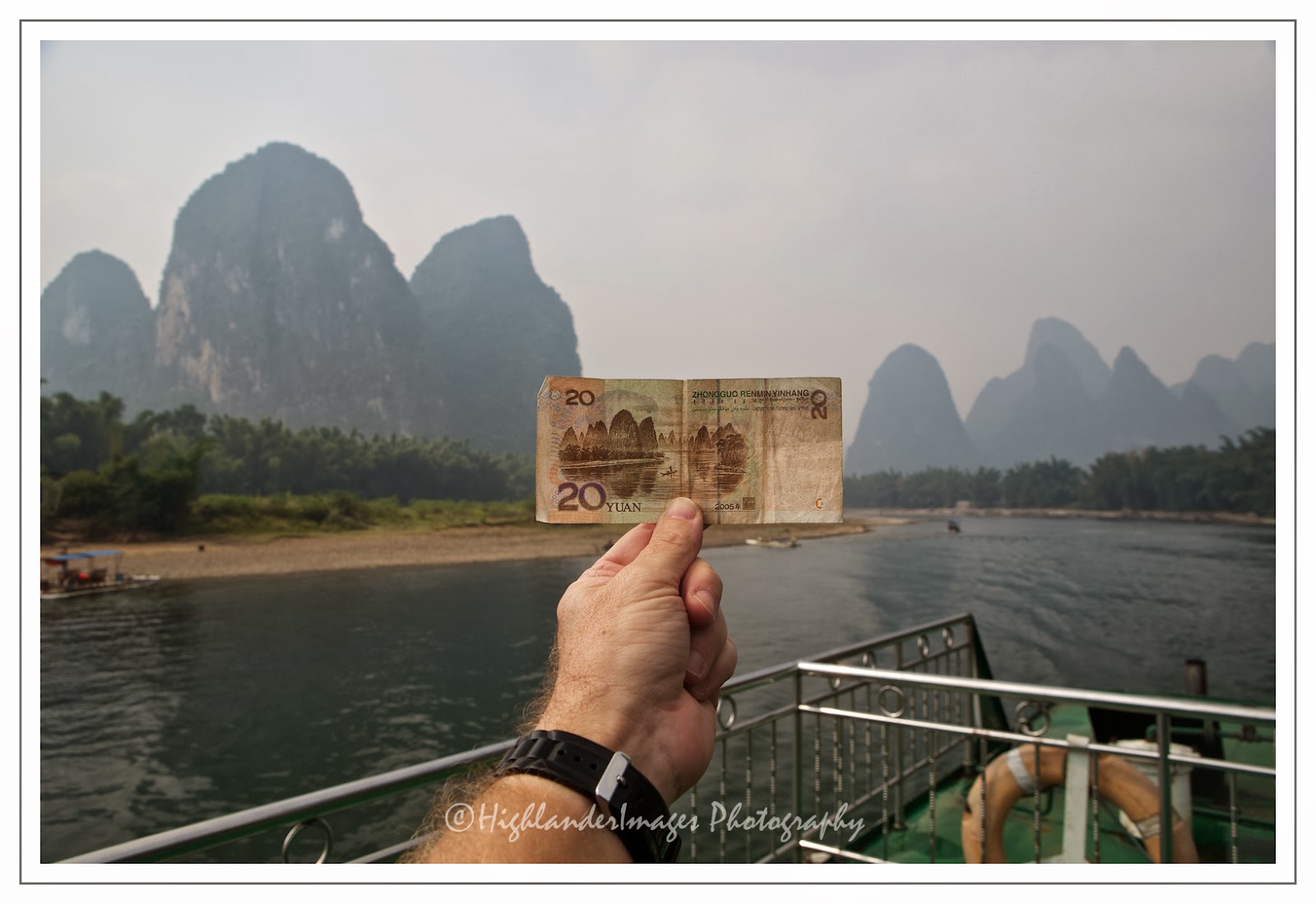
The imagery of the Li River is featured on the fifth series of the 20 yuan note.


Sunday, December 01, 2013

Daxu - Ancient Village


About 25 kilometers southeast of the city of Guilin lies Ancient Daxu ("Big Market") Town. The city, situated on the east bank of the Li River, has been a busy center of trade ever since the Qin (BCE 221-207) Dynasty period, when, under the reign (BCE 246 - 210)* of Emperor Qin Shi Huang, the Ling Canal, which connects the Xiang River of the Yangtze River watershed with the Li River of the Pearl River watershed, was dug.


Ancient Daxu's strategic placement on the banks of a river that had "spokes" leading to the Yangtze River system as well as to the Pearl River system made it a natural transit hub for trade between merchants far away and the upland population within a very large radius of the city of Daxu, since, for these areas, there was little alternative to the prosperous city on the banks of the Li River. Thirteen of the old town's shipping docks remain to this day, spread out along the city's 2 1/2-kilometer-long main street, and they bear witness to the town's former high degree of prosperity.


While photographing the Longevity Bridge in Daxu I met this interesting character who was obviously posing for the camera. He pulled out a magazine from inside his jacket and proudly showed me his photograph on a single page picture alongside all the Chinese astronauts. Not being able to communicate with him I was thinking perhaps he was an astronaut himself …. however as it turns out he is a local artist in Daxu who had won the calligraphy contest for the Chinese space mission logo. He also passed me his "business card with his name and address which is shown below.


By the time of the Northern Song (CE 960-1127) Dynasty, Daxu had achieved the status of the richest and most influential of ancient cities of what is present-day Guangxi Province, which was no mean achievement for the period. But it was during the Ming (CE 1368-1644) Dynasty that Daxu reached its pinnacle of commercial success; Wanshou Bridge, a handsome single-arched stone bridge that was built during the period, spans the Li River, while the streets of Ancient Daxu Town were - still are - paved with naturally-occurring dark-green limestone blocks, now worn to a shiny patina, thanks to centuries of use.


This local man invited me into his home to see the wonderful carved wood work. The house was a simple open arrangement with an open roof allowing the rain to fall and collect in the central depression. At the back of the house he kept his ducks and hens.


As is so often the case in general, Daxu's particular "claim to fame" - its strategic location on the banks of a busy waterway, with "spokes" radiating out to China's greatest centers of commerce, making Daxu a natural trade and traffic hub - has also proven to be the ancient city's Achilles' Heel, for during the 1930s, waterways ceded their position of prominence to railways and highways, and Daxu's commerce declined rapidly thereafter. Just as many towns and villages along the Silk Road had rapidly blossomed into important centers of commerce, then shrank with almost equal rapidity when the overland Silk Road gave way to the "Silk Road" by sea route, the burgeoning ancient town of Daxu fell into decline once its trump card, as it were, had been played out.


But unlike the many former bustling cities along the overland Silk Road that were eventually reduced to dusty ghost towns, Ancient Daxu Town continued to thrive, albeit, in a down-sized mode. The nearby river was still useful, and though regional trade might have shifted to railroads and highways, local trade and traffic still depended to a large extent on the Li River. With the emergence of the New China - and especially after the opening of China to the West - Ancient Daxu Town has seen something of a revival as a tourist venue, thanks to the hardy folk who have, in the interim, kept the city and its customs alive down through the ages.

One of the most interesting shops in the main street of Daxu is the old Chinese Herbal medicine Store with its interesting arrays of jars, potions and herbs. The old "medicine man" still practices there and can also do the traditional cupping technique. Cupping therapy is an ancient Chinese form of alternative medicine in which a local suction is created on the skin; practitioners believe this mobilizes blood flow in order to promote healing. Suction is created using heat (fire) or mechanical devices (hand or electrical pumps).


Many of Daxu's residents still ply their traditional handicrafts. Ancient Daxu Town is thus home to a number of cottage industries operated by women, such as rice-wine making and the manufacture of bamboo baskets, while Daxu men are renowned carpenters. Along the city's riverfront stand many well-preserved traditional-style buildings that date from the Ming and Qing (CE 1644-1911) Dynasties. These sturdy wooden structures - built in a quintessentially Chinese style, i.e., with colorfully decorated eaves and elegantly carved doors and windows - still serve as home to many Daxu families. A leisurely stroll along Ancient Daxu Town's main street offers an occasional glimpse into the traditional Chinese courtyard, where the sight of a grandmother surrounded by a knot of attentive children as she recounts a story about the past, or tells a fairytale, is a not uncommon sight.